
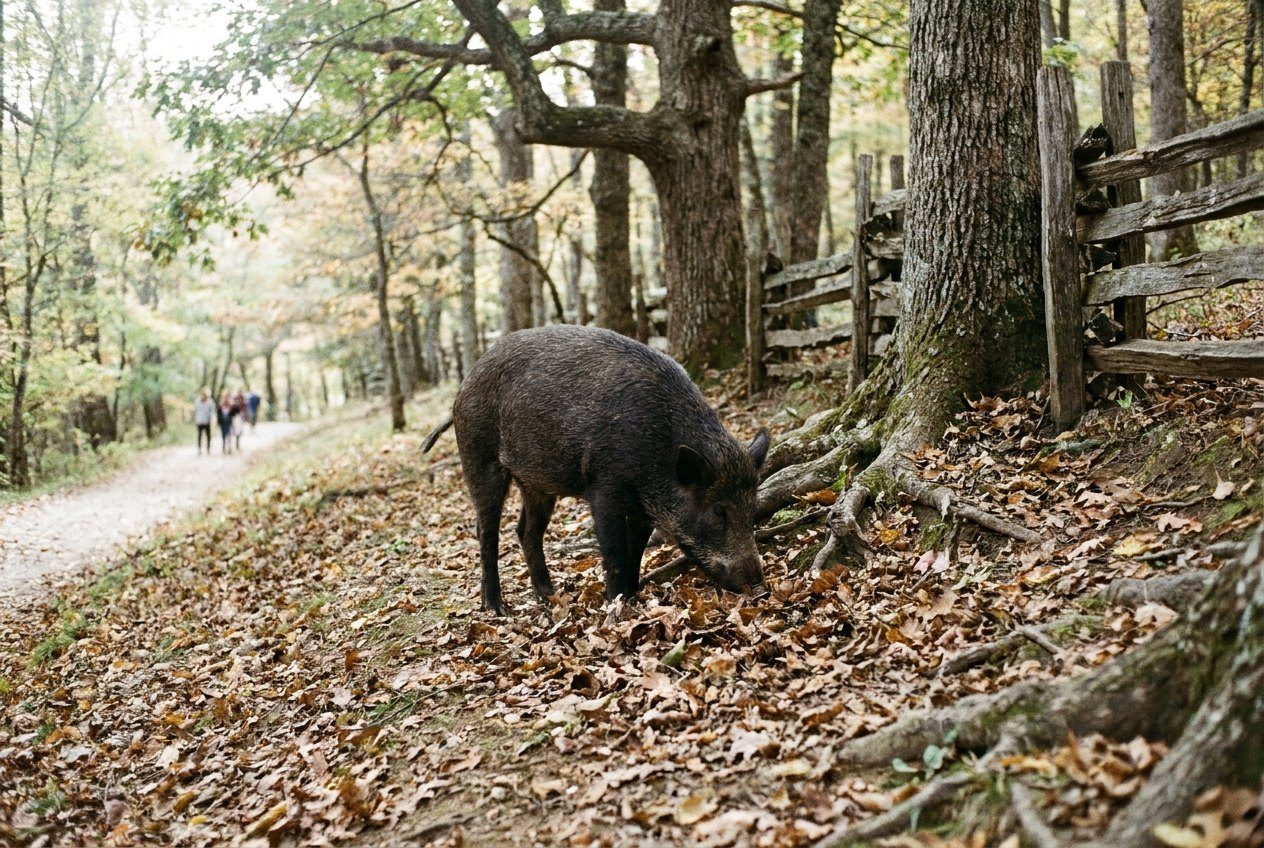
Of all the episodes in the Hatfield-McCoy story, the hog trial is the one that sounds most like a joke and was least funny to the people involved. In the autumn of 1878 Randolph McCoy, a farmer on the Kentucky side of the Tug Fork, said that a hog in the keeping of Floyd Hatfield belonged to him. Floyd said it was his. The two men took the matter to law, and the verdict, reached by neighbours and kin, left a resentment that fed into far worse events.
Hogs on open range
To understand why a single animal mattered, you have to picture the valley in the 1870s. Families raised hogs on open range, letting them forage through the woods for acorns, chestnuts and roots, then rounding them up in autumn. Ownership was shown by ear notches, each family cutting its own pattern into the ear of every hog it claimed. A hog could wander a long way through the hollows, cross a creek or a ridge, and turn up in somebody else's pen.
A good hog was real wealth for a mountain household. It meant meat and lard through the winter, and money or barter in a place with little cash. An accusation that a man had taken another man's hog was an accusation of theft, and it carried a charge of dishonesty as well as a loss of food.
The case and the court
Randolph McCoy brought his complaint before a local justice of the peace. The justice was Anderson Hatfield, known as Preacher Anse, a Hatfield cousin who was also a minister. That might look like a stacked court, but in a valley where nearly everyone was related to one family or the other, it would have been hard to find a judge with no ties at all.
The story goes that the jury was made up of six Hatfields and six McCoys, a balance meant to make the result fair. Not every account agrees on the exact makeup, but they agree that the jury included people from both families and that the outcome depended on one or two votes.
The key witness was Bill Staton, whose family was connected by marriage to both sides. He testified for Floyd Hatfield. Then one of the McCoy jurors, Selkirk McCoy, a relative of Randolph, voted with the Hatfields. The verdict went to Floyd, and the hog stayed where it was.
The witness and the juror
For the McCoys, the sting was less the lost animal than the sense of betrayal. A McCoy had voted against a McCoy. A neighbour tied to their family by marriage had sworn against them. Some later tellings say Selkirk McCoy was working for the Hatfields at the time, which, if true, would have made his vote look bought to Randolph's sons. Others note that small juries in close communities often split along working ties as much as bloodlines.
Another stop · Tug ValleyJohnse and RoseannaNobody knows now whose hog it was. The ear markings were evidently not clear enough to settle it, or the witnesses would not have mattered so much. What the record shows is that the matter was heard, a verdict was given, and the losing side did not accept it.
What came after: the death of Bill Staton
The bitterness did not fade. In June 1880 Bill Staton was killed in a fight with two of Randolph's nephews, Sam and Paris McCoy, the sons of his brother. Accounts of the fight differ on who struck first, and the outcome in court was murky as well: Sam McCoy was tried in West Virginia and acquitted on grounds of self-defence, with a Hatfield on the bench. Some writers see that acquittal as a move by Devil Anse to calm the situation; others see it simply as a jury's reading of a confused fight.
The same year, Devil Anse's son Johnse Hatfield began his relationship with Randolph's daughter Roseanna, and the two families found themselves tied together in yet another uncomfortable way. Each new event was read through the memory of the last, and the hog trial had set the pattern: a dispute settled on paper but not in people's minds. The romance is told in Johnse and Roseanna.
Why a small case mattered
Historians who look at the feud in the round tend to treat the hog trial as a symptom rather than a cause. Bad feeling between some members of the two families went back at least to the Civil War, when Asa Harmon McCoy, a Union veteran, was killed in 1865, with men linked to Devil Anse suspected. The hog case gave that older bad feeling a fresh, specific grievance, and it showed the McCoys that the local courts would not always side with them.
It also shows something about life in the valley. Disputes were small, local and personal; justice was local too, administered by men who knew everyone involved. When that system worked, it kept the peace. When it left one side feeling cheated, there were few other places to turn. Two years later, at an election gathering on Blackberry Creek, the grievances turned to open killing, as told in election day, August 1882.
Seeing the country today
There is no marked site for the hog trial, and accounts do not agree on exactly where the hearing took place. What you can see is the kind of country it happened in: steep wooded hillsides, narrow creek bottoms and back roads that follow the water. Driving the Pike County roads along the Tug in autumn, when the leaves turn and the woods are full of acorns, gives a fair sense of the open-range world the case came out of.
Much of the land along those roads is private, and many small family cemeteries sit on hillsides above the creeks. Stay on public roads, pull over only where there is a safe wide spot, and do not walk onto farms or up to houses to look around. The broader outline of the quarrel is in the feud in brief, and Randolph McCoy's own story, from this trial to his last years in Pikeville, is in Randolph McCoy.