
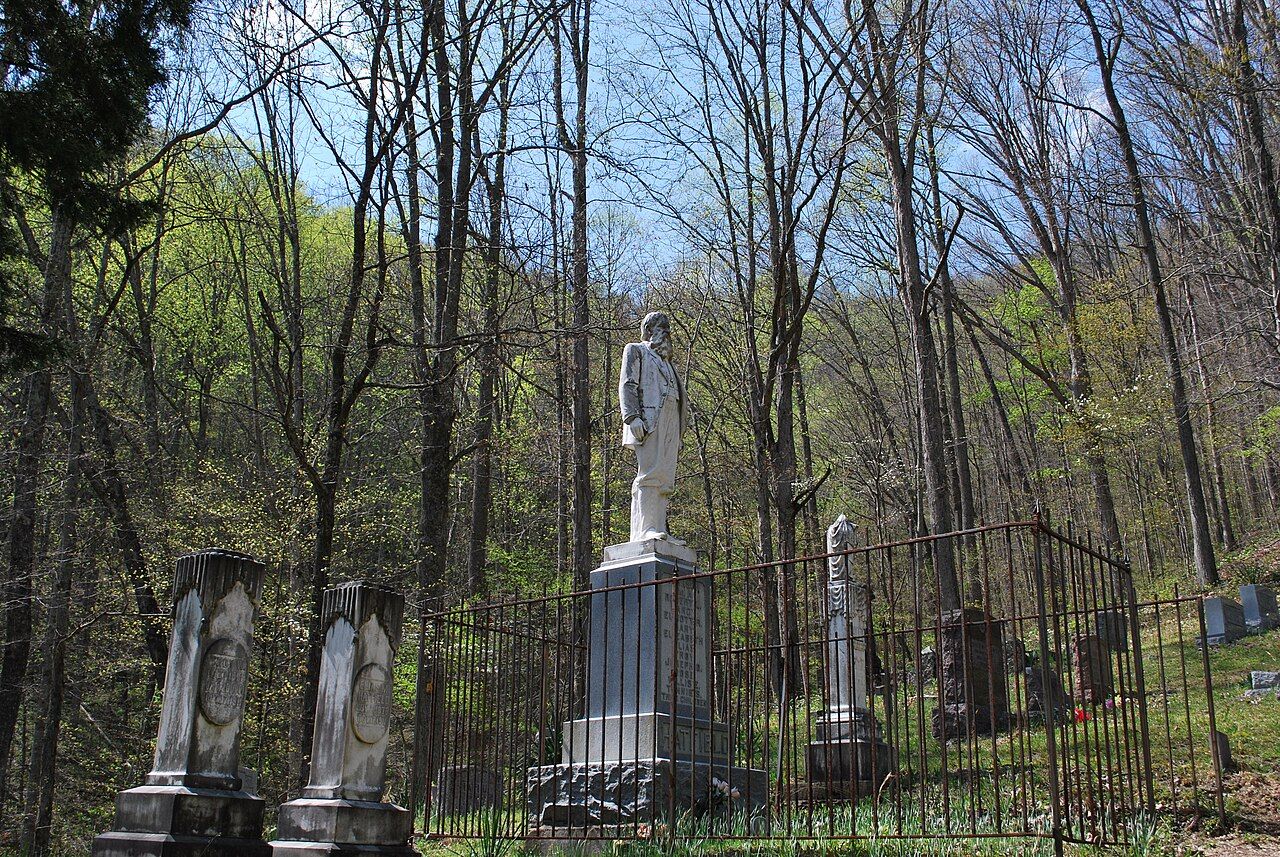

William Anderson Hatfield, known throughout his life and ever since as Devil Anse, is the best-known figure of the feud and in some ways the hardest to pin down. To his enemies he was a ruthless clan leader who ordered killings and shielded killers. To his family and many neighbours he was a capable, shrewd man who stood by his kin in hard times. The record supports parts of both pictures.
Early life and the name
Devil Anse was born in September 1839 in what was then Logan County, Virginia, along the Tug Fork. He grew up in a large family on the West Virginia side of the river, hunting, farming and working the woods. He married Levicy Chafin, and the couple had thirteen children, among them Johnse, Cap, Elias, Troy and others whose names recur in the feud.
How he got the name "Devil Anse" is uncertain. One explanation is that it set him apart from his cousin Anderson Hatfield, known as Preacher Anse, who later served as the justice of the peace in the 1878 hog trial. Another is that it came from his daring in the Civil War, or simply from his fearlessness. Accounts differ, and the name may have stuck for more than one reason.
The Civil War and the Logan Wildcats
When the Civil War came, the Tug Valley was divided in its loyalties, and Devil Anse sided with the Confederacy. He served for a time in a Confederate unit and then led, or was a leading figure in, a home guard band known as the Logan Wildcats. Such bands fought a rough guerrilla war in the mountains against Union men and Union sympathisers.
In January 1865 Asa Harmon McCoy, a brother of Randolph McCoy who had served in the Union army, was shot dead after coming home. The Logan Wildcats were suspected, and many accounts point to Jim Vance, Devil Anse's uncle, as the man who killed him. Devil Anse is not usually named as the killer, and nobody was ever tried, but the killing laid down a grievance that many date the feud from. The full outline is in the feud in brief.
Timberman and family head
After the war Devil Anse made his living largely from timber, cutting trees on the steep hillsides and floating the logs down the Tug to market. He was good at it and bought land, and for a time he was one of the more substantial men in the valley. He was also involved in a long land dispute with Perry Cline, a Pikeville lawyer related to the McCoys by marriage, that ended with Cline losing a large tract to Devil Anse. Some historians see that loss as a reason for Cline's later push to revive the feud indictments.
As the family head, Devil Anse stood at the centre of the events of the 1880s. After his brother Ellison was mortally wounded on election day in 1882, he led the party that took three McCoy brothers from Kentucky officers; they were later shot beside the Tug. He was indicted in Kentucky for those killings. He was not part of the raid on the McCoy home on New Year's night 1888, though accounts disagree about what, if anything, he knew of the plan.
Another stop · Pike CountyRandolph McCoyLater years and the 1911 baptism
Devil Anse was never tried. As the bounty hunters and posses grew bolder in the late 1880s, he moved his family farther from the river, to Island Creek in Logan County, where he lived out his life. He kept guns close and visitors were watched for years, but the killing ended around 1891 and the old man settled into a quieter life.
In 1911, at the age of about seventy-two, he was baptised in Island Creek by a well-known mountain preacher, William Dyke Garrett. The baptism drew a crowd and was widely reported. Whether it marked a deep change of heart or a public act of peace, nobody can now say, but it is one of the most remembered moments of his old age.
Death and the statue
Devil Anse Hatfield died at his home on Island Creek on 6 January 1921, of pneumonia, at the age of eighty-one. He was buried in the family cemetery on the hillside above the creek near Sarah Ann. A few years later his family placed a life-size statue of him, carved from Italian marble, over the grave. The statue shows him standing, bearded, in a long coat, and the names of his children are carved on the base.
Levicy, his wife, lies near him, as do several of their children and grandchildren. The cemetery remains a family place, cared for by descendants, and visitors are welcome so long as they come quietly. Practical notes for the climb are in the Hatfield Cemetery and Devil Anse's statue.
Weighing the man
Devil Anse has been played on film, sung about and caricatured for more than a century, and most of those versions say more about their makers than about him. The surviving record shows a man who could be generous, practical and good-humoured, who also led or protected men who killed without trial and never answered for it in court.
His counterpart across the river, Randolph McCoy, lost five children to the feud and outlived most of them. Reading their lives side by side, as in Randolph McCoy, is a good corrective to any version of the story that makes one man the villain and the other the hero.