

The raid on Randolph McCoy's home on the night of 1 January 1888 changed the feud. Up to then it had been fought mostly between the families and their friends, with local courts doing little. In the weeks and years that followed, deputies, governors, lawyers and the United States Supreme Court were all drawn in. The fighting ended in courtrooms in Pikeville, and with a hanging.
Frank Phillips and the raids across the river
Frank Phillips was a Pike County deputy with a reputation for nerve and a taste for drink. After the old indictments for the 1882 killings were revived in 1887, he began leading armed posses across the Tug into West Virginia to bring the accused men back to Kentucky. He had no extradition papers that West Virginia would recognise. To the McCoys and their supporters he was a lawman; to the Hatfields and to the government of West Virginia, he was a kidnapper.
In the days after the New Year's raid, Phillips's party caught up with Jim Vance, the uncle of Devil Anse who had led the attack on the McCoy home, and killed him. Over the following weeks the posses captured several Hatfields and their allies and carried them to the jail in Pikeville.
The Battle of Grapevine Creek
On 19 January 1888, a Phillips posse and a group of Hatfield supporters met near Grapevine Creek on the West Virginia side of the Tug. Accounts of the fight vary in their numbers and in who opened fire, but most agree that it was a running exchange of rifle shots in the woods rather than a pitched battle. Bill Dempsey, a man on the Hatfield side, was wounded and then killed. The Hatfield party withdrew.
The name "battle" came from newspapers, and it stuck. In truth it was a small and confused fight, one of several clashes that winter. What made it important was what it showed: men from one state were now crossing an interstate line with guns to make arrests in another.
Two governors and a quarrel over extradition
The governor of West Virginia, E. Willis Wilson, protested to the governor of Kentucky, Simon Bolivar Buckner, that West Virginians were being seized on their own soil and taken across the state line without due process. Kentucky replied that the men were under indictment for murder and that Kentucky had every right to try them. Each governor accused the other's side of shielding criminals. Rewards on both sides and armed men along the river made the situation tense enough that troops were discussed.
Another stop · Blackberry CreekNew Year's night, 1888West Virginia went to federal court to try to get the prisoners back, arguing that their capture had been unlawful. The case reached the United States Supreme Court as Mahon v. Justice. In 1888 the court ruled that even if a prisoner had been brought into a state unlawfully, that did not stop the state from trying him for a crime committed there. The prisoners stayed in Pikeville.
The Pikeville trials
The trials were held in Pikeville in 1889, in the Pike County courthouse of that day, an earlier building than the one that stands downtown now. Several of the accused were convicted and given life sentences for their parts in the killings of 1882 and 1888. Others were acquitted or had their charges dropped. Devil Anse and several of his sons were never brought to Kentucky and never tried.
The case of Ellison Mounts was different. Mounts, a young man often described as a son of Ellison Hatfield born outside marriage, was among those at the New Year's raid. Accounts differ on how much he understood of his trial, and some writers describe him as slow or easily led. He was convicted of the murder of Alifair McCoy and sentenced to death. On 18 February 1890 he was hanged in Pikeville in front of a large crowd. It was the only death sentence carried out in the feud.
The truce
After the trials the killing stopped. A truce is usually dated to 1891, though there was no single signed peace and no ceremony. The families went on living on their own sides of the river, some of the younger generation moved away, and the coal and the railroad began to change the valley entirely. Johnse Hatfield was arrested years later and served time in prison for his part in the New Year's raid.
The wider story is in the feud in brief. Devil Anse's later years, including his baptism in 1911, are told in Devil Anse Hatfield.
Visiting today
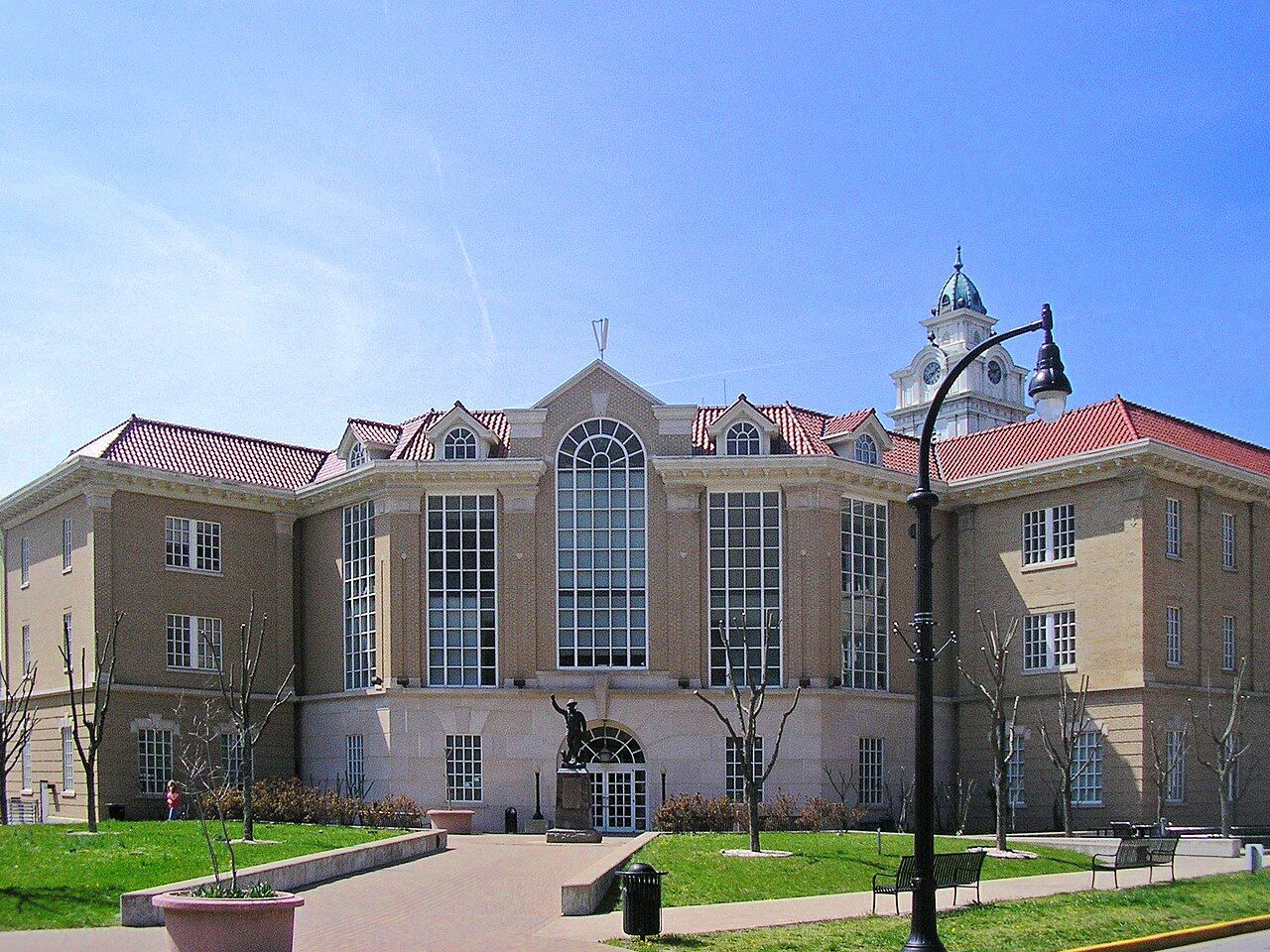
In Pikeville the courthouse stands in the middle of downtown, and historical markers nearby explain its part in the feud. The town is easy to walk, and the hillside cemetery where Randolph and Sarah McCoy lie is close by, as told in Dils Cemetery, Pikeville. The Grapevine Creek area on the West Virginia side is quiet, wooded and mostly private; there is little to see beyond the creek and the hills, and you should not leave public roads.
The town itself, with its river bend and the huge cut through the mountain, is covered in Pikeville, the McCoy side.
When you stand outside the courthouse, it helps to picture the town as it was in 1889: far smaller, with no railroad yet, reached by river and by rough roads along the valleys. Crowds came in from the hollows for the trials and again for the hanging, and the case was followed by newspapers across the country. The courthouse is a working public building, so keep to the public areas and be mindful of people there on court business.