
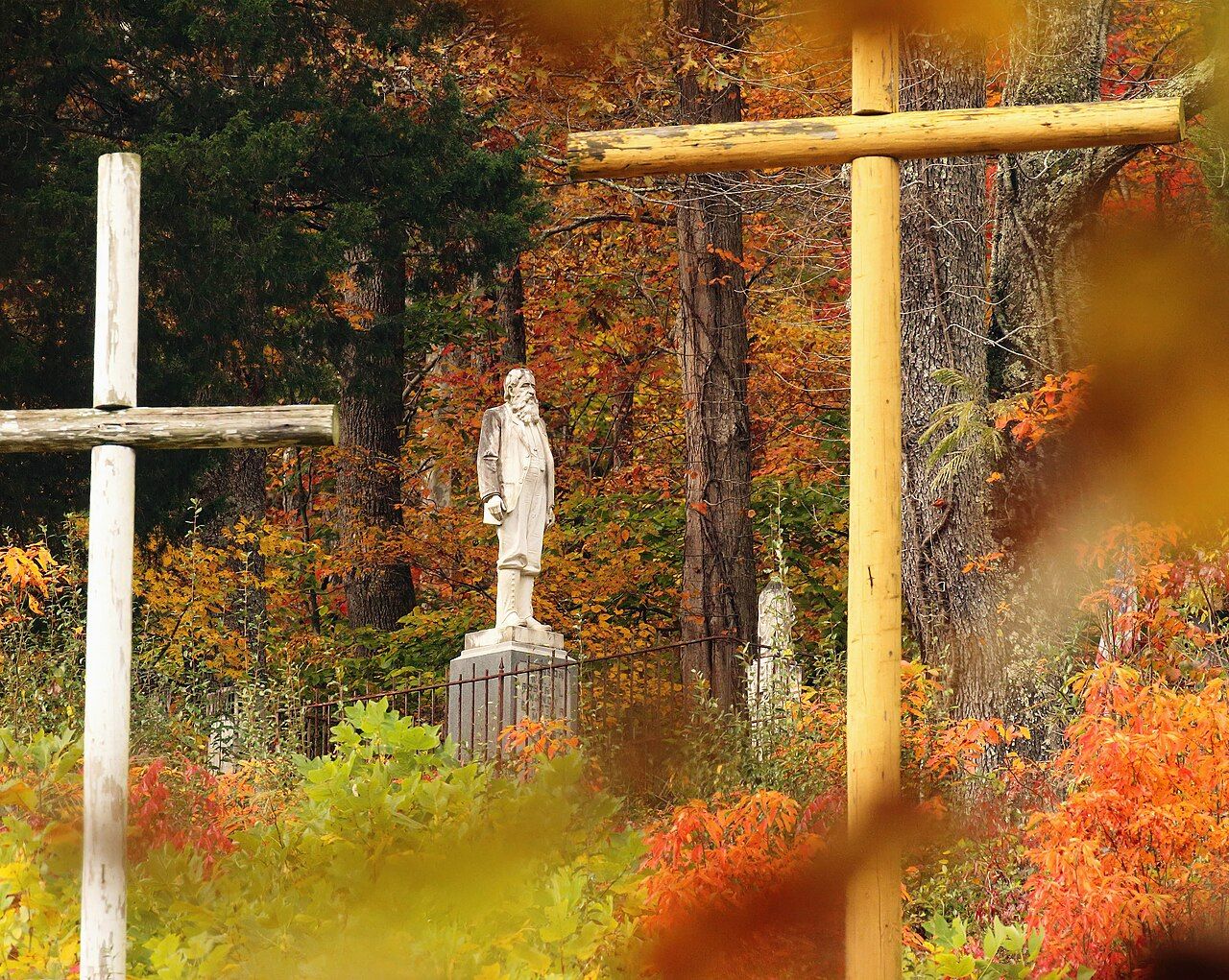

The most visited grave in feud country sits on a hillside in Logan County, West Virginia, a short way up from the road through the Island Creek valley near the small community of Sarah Ann. Here William Anderson Hatfield, Devil Anse, lies under a life-size marble statue of himself, surrounded by family. The setting is quiet, wooded and steep, and a visit takes less time than the drive to get there, but few places in the region tell the story of the feud's end as clearly.
Where it is and how to find it
The cemetery lies along West Virginia Route 44, which runs south from the Logan area up the Island Creek valley. Sarah Ann is a former coal community strung along the road and the creek. Look for signs near the road marking the cemetery; from a small pull-off a steep path leads up the hillside.
Phone signal is unreliable in the valley, so set your route before you leave Logan or Williamson. Route 44 is a working road, used by coal trucks and local traffic, with tight curves and few places to stop. Pull fully off the road, never stop in a curve, and take care getting in and out of the car.
Getting there by those winding roads is half the experience. Route 44 follows Island Creek through a narrow valley, with steep wooded slopes rising close on both sides and houses, churches and small communities lining the flat ground by the water. Leave plenty of time, because the road is slow, and fill the tank in a larger town before you set out. If a truck comes up behind you, find a safe place to let it pass.
The climb
The walk up from the road is short but steep. In dry weather most people manage it in a few minutes, taking it slowly. After rain the path can be muddy and slick, and in autumn wet leaves hide the footing. Wear proper shoes rather than sandals. There are no facilities at the cemetery, so plan ahead.
If the climb is too much for someone in your group, the statue can be glimpsed from lower down, though the view is partly blocked by trees in summer. Late autumn and early spring, when the leaves are off, give the clearest sight lines.
The statue
Devil Anse died at his home on Island Creek on 6 January 1921, at the age of eighty-one, and was buried here. A few years later his family raised a life-size statue of him in Italian marble. The story goes that it was carved in Italy, shipped to the mountains and hauled up the hillside by hand and by mule. The figure stands on a tall stone base, bearded, in a long coat, looking out over the valley.
The carving shows him as an old man rather than as the young guerrilla of the Civil War years, with a full flowing beard and a calm, upright stance. Seen against the trees, the white marble stands out sharply from the grey and weathered headstones around it. Spend a few minutes walking around the fence rather than taking one quick photograph from the front, and the detail of the face, the coat and the lettering becomes much clearer.
The base carries his name and the names of his children, and much of the family's history can be read from it. The statue is enclosed by an iron fence, and the marble has weathered over the decades, which is one reason the family asks visitors not to touch it. His wife, Levicy, is buried close by, and several of their children and later generations lie in the plots around them.
The whole of his life, from the Logan Wildcats to his baptism in 1911, is told in Devil Anse Hatfield.
Another stop · Pike CountyRandolph McCoyThe base carries his name and the names of his children, and much of the family's history can be read from it.
A family cemetery, not an attraction
The Hatfield Cemetery is listed on the National Register of Historic Places, and it is open to respectful visitors, but it remains a family burying ground. Descendants still care for it, and that shapes how you should behave.
- Stay on the paths and do not climb on or lean against stones, the fence or the statue base.
- Do not take anything away, not even a pebble or a leaf from a grave.
- Keep voices low, and keep children close.
- Photograph the statue and the setting, but avoid photographing any family members you may meet there tending graves.
- If a burial or family gathering is taking place, leave and come back another time.
- Take your rubbish down with you.
- Do not make rubbings of the inscriptions; they wear the stone.
- Keep pets on a lead and well away from the graves, or leave them in the care of someone at the car.
Remember too that the graves around the statue are less famous but no less important to the people who tend them. Many visitors walk straight to Devil Anse and back. Take a moment instead to read the other stones, which carry the names of wives, children and grandchildren who lived ordinary lives in the valley long after the feud was over.
If you feel the need to leave something, a simple flower is the most respectful choice, and even that is optional.
The Island Creek valley
Island Creek is where Devil Anse moved his family in the late 1880s, farther from the Tug Fork and from the posses that crossed it. It was there that he lived out his later life, and there, in the creek, that he was baptised in 1911. Soon after his time, coal mining transformed the valley, bringing railroad spurs, company towns and new people. Sarah Ann and the communities around it grew up with the mines.
Today the valley is quieter, with the remains of the coal era scattered along the road. Old mine sites have grown over, and many of the houses are the plain frame homes typical of former coal camps. People still live and work here, so treat it as a lived-in place rather than an open-air museum. Driving it gives a sense of how the feud country changed after 1891: from scattered farms and timber cutting to coal camps and railroad towns, as covered in coal and the Norfolk and Western.
Fitting it into a drive
The cemetery pairs well with the McCoy sites across the river: Randolph and Sarah McCoy's graves in Pikeville and the homeplace on Blackberry Creek. Seeing both families' resting places on the same trip gives a balanced picture of a quarrel that took lives on both sides. A sensible order for the drive, including where the roads are narrowest, is in driving feud country.
Allow time. The roads between the sites are slow, and there is little point in rushing a visit to a grave. Spring brings dogwood and redbud to the hillsides, and October brings colour; either makes the climb more rewarding. Winter visits are possible, but ice on the path and the road calls for extra caution.