
By the end of 1887 the Hatfield-McCoy quarrel had been quiet, if not settled, for several years. The killings of August 1882 had led to indictments in Pike County, Kentucky, but the accused Hatfields lived in West Virginia and nobody had brought them to trial. Then the old charges were revived, rewards were offered, and armed men began to cross the Tug looking for the accused. The Hatfields' answer came on the night of 1 January 1888, and it was the most notorious act of the whole feud.
Why the old charges came back
In 1887 Perry Cline, a Pikeville lawyer and a relative of the McCoys by marriage, persuaded the new governor of Kentucky, Simon Bolivar Buckner, to press for the arrest of the men indicted for the 1882 killings. Rewards were posted. Frank Phillips, a Pike County deputy, began organising posses to bring Hatfields back across the river.
Some of the Hatfield circle concluded that the case against them depended on witnesses, and that Randolph McCoy and his family were the most important of them. The story goes that the plan was to remove the witnesses before they could testify. Whether it was meant from the start to end in killing, or went further than intended once it began, is one of the questions accounts answer differently.
The cabin on Blackberry Creek
Randolph and Sarah McCoy lived on Blackberry Creek in Pike County, in a log house with outbuildings, a few miles from the Tug. Several of their children still lived at home, among them their daughter Alifair, in her late twenties or about thirty, and their son Calvin, in his early twenties.
On the night of New Year's Day a party of about eight or nine men crossed into Kentucky and came to the house in the dark. It was led by Jim Vance, an uncle of Devil Anse, and Cap Hatfield, one of Devil Anse's sons. Johnse Hatfield and Ellison Mounts are usually named among them. Devil Anse himself was not there; most accounts place him at home, and his part in the planning, if any, is disputed.
The attack
The raiders called for Randolph to come out. When he did not, they opened fire on the house, and then set it alight. Accounts differ on the exact order of events and on who fired which shots, and many lines of dialogue in later books are invention.
Alifair McCoy went out of the burning house and was shot dead. Her mother, Sarah, went to her and was beaten badly enough that her skull was injured and she was left for dead; she survived, though her health never fully recovered. Calvin McCoy was killed as he ran from the house, drawing fire, it is often said, so that his father could get away.
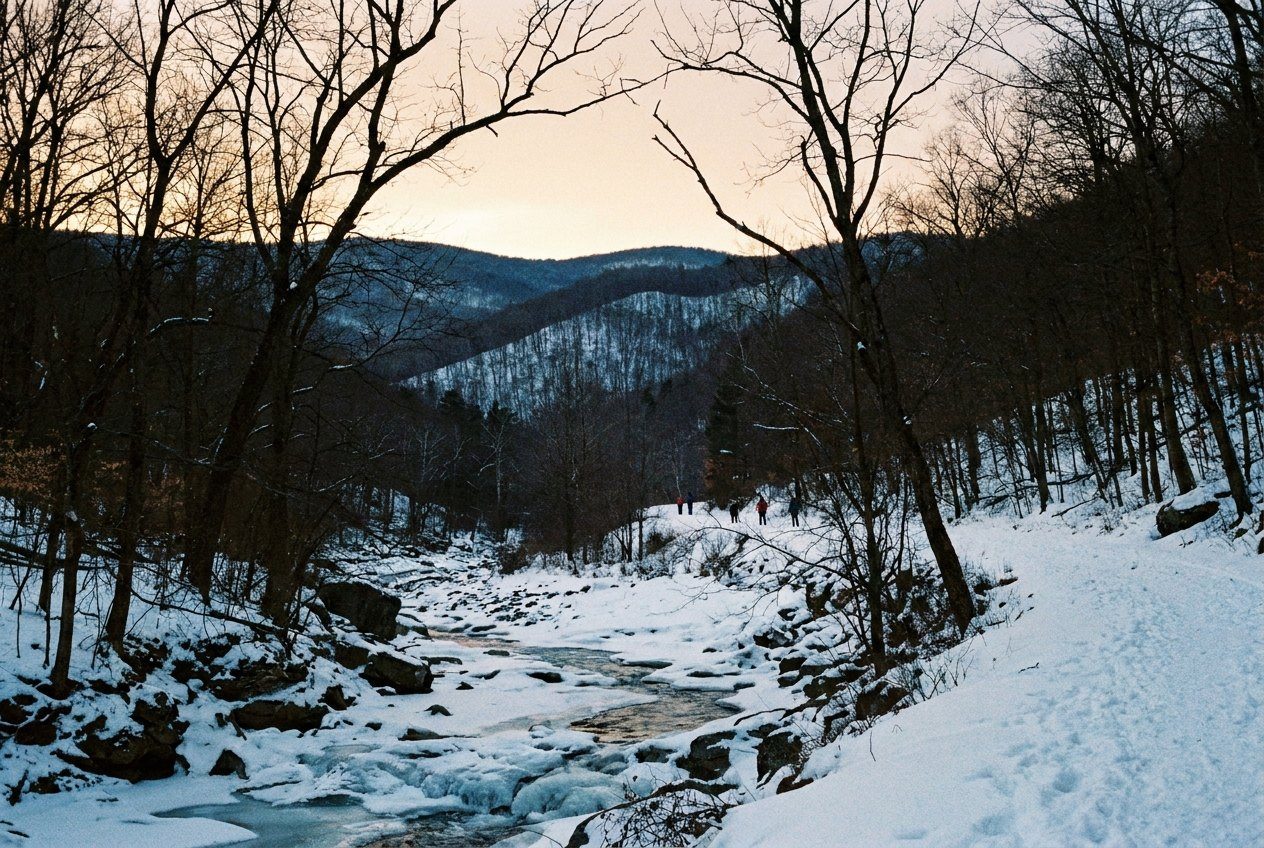
Another stop · Blackberry CreekElection day, August 1882It was the depth of winter, and the cold made the night all the more desperate for those who fled the house. Randolph McCoy escaped into the darkness and the cold. The house burned. Some of the other children survived by hiding or fleeing. When the raiders left, two of the McCoy children were dead and the family home was gone.
Flight to Pikeville
After the raid, Randolph and Sarah McCoy did not go back to Blackberry Creek to live. They moved to Pikeville, the county seat, where they spent the rest of their lives. Alifair and Calvin were buried in the family cemetery near the old home, beside their brothers killed in 1882.
For Randolph, the losses had now reached five children killed by violence connected to the feud. His later years are told in Randolph McCoy, and the cemetery where he and Sarah lie is in Dils Cemetery, Pikeville.
Public outrage and what followed
The raid shocked people well beyond the valley. Killing a woman and a young man, beating their mother and burning the house in midwinter was hard for anyone to explain away, and newspapers far from the mountains seized on the story. Opinion that had been divided now ran firmly against the Hatfields.
Frank Phillips's posses stepped up their raids into West Virginia. Within days Jim Vance was dead, killed by a Phillips party. Several Hatfield allies were captured and taken to Pikeville. Later in January the two sides met in the fight on Grapevine Creek, and the arrests set off a dispute between the governors of Kentucky and West Virginia that reached the United States Supreme Court. Ellison Mounts was later convicted of Alifair McCoy's murder and hanged in Pikeville in 1890. That chain of events is told in Grapevine Creek and the courtroom feud.
The homeplace today
The site of the McCoy home on Blackberry Creek is marked, and a well associated with the homestead is often pointed out to visitors. The land around it is lived on, and the families nearby have every right to their privacy. A short stop is plenty: read the marker, take in the narrow valley and move on.
The family cemetery where Alifair and Calvin lie beside their three brothers is on private land nearby. Do not go looking for it on foot without the owners' permission.
Winter visits give the clearest sense of how exposed the valley would have been on that January night, with bare trees on the ridges and frost on the creek. Roads can be icy then, so check the forecast and drive slowly. In any season, keep the visit quiet. This is a place where two people were killed, and it deserves the same respect you would give any family's grave.
Back to The feud, year by year